Feeds:
Posts
Comments

Archive for the ‘corporate green’ Category

deutsche-bank-green-bankPresident-elect Barack Obama may dismiss notions of a New New Deal to stave off a Great Depression 2.0, but signs of a Rooseveltian shift in thinking abound.

Case in point: This week, Deutsche Bank called for the establishment of a “national infrastructure bank” to create “green” jobs, fight global warming and ensure U.S.  energy independence by investing in an array of projects – from energy efficiency to upgrading the Eisenhower-era power grid to large-scale renewable energy power plants.

The idea of a national infrastructure bank is not new – versions have been proposed by Obama and Senators Chris Dodd (D-Conn.) and Chuck Hagel (R-Neb.) to finance the repair of the nation’s crumbling highways, water systems and cities. Deutsche’s twist is to give such an institution a green mission.

“We believe this confluence opens up an historic opportunity for a new U.S. administration and Congress to take a global leadership position on the issue of the environment and energy security, while addressing current financial problems,”  wrote Deutsche Bank’s Climate Change Investment Research team in its report.

“We’re calling for the national infrastructure bank to go green because in the long run it will save us money and create more jobs,” Deutsche senior investment analyst Bruce Kahn told Green Wombat.

He says Deutsche Bank is not putting a dollar figure on the capitalization of such bank, but the report notes others have suggested a $100 billion investment would generate two million green jobs.

Deutsche Bank (DB) recommends a green infrastructure bank focus on energy efficiency, the transmission grid, renewable energy and public transportation. The green bank would dispense federal funding, make grants to states and cities, issue loans to governments and companies, underwrite public and private bonds, and provide tax credits for public and private projects.

In Deutsche Bank’s analysis, the biggest bang for the buck would come from a massive retrofit program to increase the energy efficiency of the nation’s commercial buildings and make sure the 1.8 million new homes constructed every year are green. Buildings consume as much as 50% of the electricity generated in urban areas and emit about 20% of the country’s greenhouse gases. The work of installing energy-efficient heating, lighting and air conditioning systems is labor intensive and would spike demand for green building materials.

Upgrading and digitizing the power grid to create a “transmission super highway” to bring solar and wind energy from the deserts and Great Plains to the cities could generate as many as 500,000 jobs, according to an estimate by the American Wind Energy Association. The price tag to modernize the grid: $450 billion over the next 15 years by New Energy Finance’s estimate.

One area given short shrift by the Deutsche report is how a green infrastructure bank would support large-scale renewable energy power plants. Wind farms and solar power stations typically require billions of dollars in financing to get built and rely on investors buying the tax credits the projects generate. Those investors have been in short supply thanks to the credit crunch and the collapse of the Wall Street banks that often put up the cash for such deals.

“Everyone’s lost money, there’s no tax equity to be had,”  says Kahn. “But we expect that tax credit equity investors will return to the market, not next month, but in the next couple of years.” Kahn says an infrastructure bank could support green energy power plant projects through loans and loan guarantees.

A green bank would also be good business for Deutsche Bank.

“We have large number of investments at stake, current investments in all these sectors,” says Kahn. “It provides an investment opportunity as this infrastructure bank would not be able to exist all on its own. It would need private capital to invest alongside it.”

Read Full Post »

SAN FRANCISCO – Google and General Electric said Wednesday that they will collaborate on developing geothermal power as well as technology to enable plug-in vehicles to return electricity to the grid.

During Google’s (GOOG) annual Zeitgeist conference at its Silicon Valley headquarters, Google CEO Eric Schmidt and GE (GE) chief Jeff Immelt said the two giants also would team up to push for policy changes in Washington to develop smart electricity grids to allow the widespread deployment of renewable energy.

“There’s two fundamental things that have to be done, and which we’re working with Google on,” said Immelt before an audience that included former Vice President Al Gore. “One, there has to be more capacity. The second thing is there has to be a smart grid to allow it to operate more effectively. That’s primarily software. We make the hardware.”

Schmidt quizzed Immelt about the impact of the Wall Street meltdown on green energy. “Will the craziness of last week screw some of this stuff up?” asked Schmidt. “Are we going to get set back for years because of all the shenanigans in the financial industry?”

“People should be concerned but not panicked,” replied Immelt. “The federal government is doing the right thing.”

Gore was not so sanguine, noting that Congress has failed repeatedly to extend crucial investment tax credits for renewable energy. “While Congress is voting on oil drilling and leasing oil shale – which is a move that would be game over for the climate crisis – they’re preparing to filibuster over renewable energy tax credits,” he said.

Google and GE are among scores of Fortune 500 companies that have lobbied Congress to extend the investment tax credit and the production tax credit, which is particularly important to the wind industry. ”

“I’m a lifelong Republican and I believe in free markets but over time we worship false idols,” says Immelt. “Sometimes we think the free market is whatever the price of oil is today. In the end, clean energy is both a technology and a public policy.”

He noted that because the production tax credit allowed the wind industry to scale up, wind-generated electricity now costs about six-to-seven cents a kilowatt hour, down from 15 cents 15 years ago.

“We bought Enron’s wind business for a few million dollars and now it’s worth $7 to 8 billion,” Immelt said. “I’ve made some bad decisions but that wasn’t one of them.”

Google in August invested nearly $11 million in geothermal companies developing so-called enhanced geothermal systems technology to allow the earth’s heat to be tapped nearly anywhere and turned into electricity. On Wednesday, Google and GE said they will work on technology to transform geothermal into a large-scale source of green electricity.

In a statement, the two companies said they will also “explore enabling technologies including software, controls and services that help utilities enhance grid stability and integrate plug-in vehicles and renewable energy into the grid.”

Image: Google

Read Full Post »

Illustration: Genomatica

Outside of ExxonMobil (XOM), petrochemical companies would seem to be the least likely to join the sustainability movement sweeping corporations worldwide. After all, how do you green an industry predicated on petroleum as a key ingredient?

The answer, according to San Diego startup Genomatica, is to replace hydrocarbons with carbohydrates. The company is announcing Tuesday that it has bioengineered a microorganism that ingests sugar and water to produce a chemical called 1,4‐butanediol. Commonly known as BDO, the chemical is a raw material found in everything from golf balls to skateboard wheels to spandex. Although Genomatica is planning a pipeline of bioengineered chemicals, BDO alone is a $4 billion business.

“By using carbohydrates versus hydrocarbons, we can produce BDO with less energy and that translates into a smaller carbon footprint,” Genomatica CEO Christopher Gann told Green Wombat.

So far, Genomatica – founded in 2000 and backed by marquee Silicon Valley venture capital firms Mohr Davidow Ventures and Draper Fisher Jurvetson – has only produced batches of BDO in the laboratory. But Gann,  a veteran of Dow Chemical (DOW), and company president Christophe Schilling claim that by the middle of 2009 they will be able to make bioengineered BDO cheaper than the petroleum-based chemical.

“This is a disruptive technology,” Gann says.

If Genomatica lives up to its claims of success in the lab, the technology indeed could potentially turn the petrochemical industry on its head.

First, anything that removes petroleum from a manufacturing process is going to get noticed. (While transportation accounts 70% of the 20.7 million barrels of oil consumed in the United States daily, a significant portion is used for chemicals  – up to 25% in the gulf states home to the nation’s petrochemical industry, according to the U.S. Energy Information Administration.)

Second, Genomatica’s microorganism leaves behind none of the nasty byproducts of petrochemical production, avoiding the health risks and costs of containing, storing and cleaning up toxic waste.

Lastly, Gann and Schilling say Genomatica’s technology frees BDO production from vast and accident-prone petrochemical complexes. “Since the raw materials are sugar and water, we can locate next to where there’s sugar and water or locate next to where the product can be consumed,” says Gann.

The startup was spun out of the University of California at San Diego, where Schilling and his mentor, Professor Bernhard Palsson, developed a technology platform to design virtual microorganisms. Schilling compares the process to the way airliners are designed entirely on computers.

“It allows us to model and simulate how microorganisms would survive and grow,” he says. “We can now go ahead and figure out the best way to engineer the organism to perform a particular task. We use off-the-shelf technologies and some proprietary ones to produce the organisms.”

Genomatica, which has raised $20 million from the Silicon Valley VCs as well as some Icelandic angel investors, will make money by licensing its technology to chemical companies. Gann and Schilling declined to identify other chemicals in their product pipeline but said they were related to the class of petrochemicals known as “cracker-plus-one.”

Read Full Post »

When Intel announced this week that it was spinning off a stealth in-house startup called SpectraWatt to develop solar cells, it appeared the chip giant was just the latest old-line Silicon Valley tech firm bitten by the green bug.

After all, crosstown chipmaker Cypress Semiconductor jumped into the solar game back in 2004 when it acquired SunPower (SPWR), now a leading manufacturer of solar cells and panels and an installer of large-scale solar arrays. Then the world’s biggest chip-equipment maker, Applied Materials (AMAT), retooled machines that make flat-screen video displays to produce thin-film solar panels. And just this month, Hewlett-Packard (HPQ) unveiled a deal to license solar technology to a solar cell startup while IBM (IBM) announced it would develop thin-film solar.

But it’s not just now jumping on the enviro-biz bandwagon – Intel’s solar efforts have been quietly under development since 2004. That’s when Andrew Wilson, an 11-year Intel (INTC) veteran, was chatting with a colleague while waiting for a conference call to begin. “We were shooting the breeze and I mentioned that I had replaced all the light bulbs in my house with compact fluorescent lights and my utility bill had come down by a third,” says Wilson, SpectraWatt’s CEO. “And he said, `Hey, did you know that solar cells are made of silicon?’ ”

“We started talking about what a business plan would look like, because if something is made out of silicon then Intel should be taking advantage of that market,” Wilson told Fortune. A year later, Wilson and his colleagues had developed a marketing plan and secured funding from Intel’s new-business incubator to develop a business strategy and hone its technology. (It’s no coincidence that the nascent solar industry is populated by computer industry veterans from companies that put the silicon in Silicon Valley.)

When it comes to cutting-edge solar technology, silicon-based cells are considered a bit old-school. Silicon is currently in short supply and the resulting high prices have led venture capitalists to invest hundreds of millions of dollars in thin-film solar startups that promise to dramatically lower the cost of solar by printing or otherwise applying non-silicon solar cells to glass or flexible materials that can be integrated into walls, windows and other building materials. While thin-film solar is less efficient at converting sunlight into electricity, the expectation is that it can be produced much more cheaply than conventional cells.

But thin-film solar is still largely an early-stage technology and silicon-based cells will continue to be the big market for the near-future. So the question is, how does Intel compete with established players like SunPower, China’s Suntech (STP) and Germany’s Q-Cells as solar cells become a commodity? Intel controls some 80 to 90 percent of the worldwide chip market but it’s unlikely that it – or any other player – will replicate that experience in solar cells.

Wilson’s view is that it’s early days for the solar market and that SpectraWatt’s ace in the hole is Intel’s global manufacturing experience and history of technological innovation. “The solar industry today looks like the microelectronics industry in the late ‘70s – there’s very few standards and no one is manufacturing at scale,” says Wilson. “It’s all about manufacturing processes and material sciences that will lead to fundamental breakthroughs. The product is vastly simpler than a microprocessor but the fundamental nature of a solar cell isn’t all that different. When you think of what it takes to manufacture globally and manage supply chains, that’s Intel’s core competence.”

There certainly is room for more players, given that solar was a $30 billion market in 2007 and is expected to continue to grow at a clip of 30 to 40 percent in the coming years.

Wilson says SpectraWatt has secured silicon supplies and is developing technology that will give it a competitive edge. He’s keeping mum about the details of that technology for now. “We do believe we will have a technological advantage when we get what we’re doing in the lab to manufacturing,” Wilson says.

The company is set to begin building its manufacturing facility in Oregon later this year, with production to begin in mid-2009.

SpectraWatt launches with a $50 million investment lead by Intel Capital, the company’s investing arm. Other investors include Goldman Sachs (GS), PCG Clean Energy and Technology Fund, and German solar giant Solon. (As Green Wombat has written, Solon has invested in an array of solar startups in the United States, including Sungevity and thin-film solar company Global Solar.)

Read Full Post »

“Years ago we came to the conclusion that global warming was a problem, it was an urgent problem and the need for action is now. The problem appears to be worse and more imminent today, and the need to take action sooner and take more significant action is greater than ever before” — PG&E Chairman and CEO Peter Darbee

The head of one of the nation’s largest utilities seemed to be channeling Al Gore on Tuesday when he met with a half-dozen environmental business writers, including Green Wombat, in the PG&E (PCG) boardroom in downtown San Francisco. While a lot of top executives talk green these days, for Darbee green has become the business model, one that represents the future of the utility industry in a carbon-constrained age.

As Katherine Ellison wrote in a feature story on PG&E that appeared in the final issue of Business 2.0 magazine last September, California’s large utilities — including Southern California Edison (EIX) and San Diego Gas & Electric (SRE) — are uniquely positioned to make the transition to renewable energy and profit from green power.

First of all, they have no choice. State regulators have mandated that California’s investor-owned utilities obtain 20 percent of their electricity from renewable sources by 2010 with a 33 percent target by 2020. Regulators have also prohibited the utilities from signing long-term contracts for dirty power – i.e. with the out-of-state coal-fired plants that currently supply 20 percent of California’s electricity. Second, PG&E and other California utilities profit when they sells less energy and thus emit fewer greenhouse gases. That’s because California regulators “decouple” utility profits from sales, setting their rate of return based on things like how well they encourage energy efficiency or promote green power.

Still, few utility CEOs have made green a corporate crusade like Darbee has since taking the top job in 2005. And the idea of a staid regulated monopoly embracing technological change and collaborating with the likes of Google (GOOG) and electric car company Tesla Motors on green tech initiatives still seems strange, if not slightly suspicious, to some Northern Californians, especially in left-leaning San Francisco where PG&E-bashing is local sport.

In a wide-ranging conversation, Darbee, 54, sketched sketched a future where being a successful utility is less about building big centralized power plants that sit idle until demand spikes and more about data management – tapping diverse sources of energy — from solar, wind and waves to electric cars — and balancing supply and demand through a smart grid that monitors everything from your home appliances to where you plugged in your car. “I love change, I love innovation,” says Darbee, who came to PG&E after a career in telecommunications and investment banking.

Renewable energy

“On renewable energy what we’ve seen is the market is thin,” says Darbee. “Demand just from ourselves is greater than supply in terms of reliable, well-funded companies that can provide the service.”

PG&E so far has signed power purchase agreements with three solar startups — Ausra, BrightSource Energy and Solel — for up to 1.6 gigawatts of electricity to be produced by massive solar power plants. Each company is deploying a different solar thermal technology and uncertainty over whether the billion-dollar solar power stations will ultimately be built has prompted PG&E to consider jumping into the Big Solar game itself.

“We’re looking hard at the question of whether we can get into the business ourselves in order to do solar and other forms of renewables on a larger scale,” Darbee says. “Let’s take some of the work that’s been done around solar thermal and see if we can partner with one of the vendors and own larger solar installations on a farm rather than on a rooftop.”

“I like the idea of bringing the balance sheet of a utility, $35 billion in assets, to bear on this problem,” he adds.

It’s an approach taken by the renewable energy arm of Florida-based utility FPL (FPL), which has applied to build a 250-megawatt solar power plant on the edge of the Mojave Desert in California.

For now, PG&E is placing its biggest green bets on solar and wind. The utility has also signed a 2-megawatt deal with Finavera Renewables for a pilot wave energy project off the Northern California coast. Given the power unleashed by the ocean 24/7, wave energy holds great promise, Darbee noted, but the technology is in its infancy. “How does this technology hold up against the tremendous power of the of the Pacific Ocean?”

Electric cars

Darbee is an auto enthusiast and is especially enthusiastic about electric vehicles and their potential to change the business models of both the utility and car industries. (At Fortune’s recent Brainstorm Green conference, Darbee took Think Global’s all-electric Think City coupe for a spin and participated in panels on solar energy and the electric car.)

California utilities look at electric cars and plug-in hybrids as mobile generators whose batteries can be tapped to supply electricity during peak demand to avoid firing up expensive and carbon-spewing power plants. If thousands of electric cars are charged at night they also offer a possible solution to the conundrum of wind power in California, where the breeze blows most strongly in the late evenings when electricity demand falls, leaving electrons twisting in the wind as it were.

“If these cars are plugged in we would be able to shift the load from wind at night to using wind energy during the day through batteries in the car,” Darbee says.

The car owner, in other words, uses wind power to “fill up” at night and then plugs back into the grid during the day at work so PG&E can tap the battery when temperatures rise and everyone cranks up their air conditioners.

Darbee envisions an electricity auction market emerging when demand spikes. “You might plug your car in and say, ‘I’m available and I’m watching the market and you bid me on the spot-market and I’ll punch in I’m ready to sell at 17 cents a kilowatt-hour,” he says. “PG&E would take all the information into its computers and then as temperatures come up there would be a type of Dutch auction and we start to draw upon the power that is most economical.”

That presents a tremendous data management challenge, of course, as every car would need a unique ID so it can be tracked and the driver appropriately charged or credited wherever the vehicle is plugged in. Which is one reason PG&E is working with Google on vehicle-to-grid technology.

“One of the beneficiaries of really having substantial numbers of plug-in hybrid cars is that the cost for electric utility users could go down,” says Darbee. “We have a lot of plants out there standing by for much of the year, sort of like the Maytag repairman, waiting to be called on for those super peak days. And so it’s a large investment of fixed capital not being utilized.” In other words, more electric and plug-in cars on the road mean fewer fossil-fuel peaking power plants would need to be built. (And to answer a question that always comes up, studies show that California currently has electric generating capacity to charge millions of electric cars.)

Nuclear power

Nuclear power is one of the hotter hot-button issues in the global warming debate. Left for dead following the Three Mile Island and Chernobyl disasters, the nuclear power industry got a new lease on life as proponents pushed its ability to produce huge amounts of carbon-free electricity.

“The most pressing problem that we have in the United States and across the globe is global warming and I think for the United States as a whole, nuclear needs to be on the table to be evaluated,” says Darbee.

That’s unlikely to happen, however in California. The state in the late 1970s banned new nuclear power plant construction until a solution to the disposal of radioactive waste is found. PG&E operates the Diablo Canyon nuclear plant, a project that was mired in controversy for years in the ’70s as the anti-nuke movement protested its location near several earthquake faults.

“It’s a treasure for the state of California – It’s producing electricity at about 4 cents a kilowatt hour,” Darbee says of Diablo Canyon. “I have concerns about the lack of consensus in California around nuclear and therefore even if the California Energy Commission said, `Okay, we feel nuclear should play a role,’ I’m not sure we ought to move ahead. I’d rather push on energy efficiency and renewables in California.”

The utility industry

No surprise that Darbee’s peers among coal-dependent utilities haven’t quite embraced the green way. “I spent Saturday in Chicago meeting with utility executives from around the country and we’re trying to see if we can come to consensus on this very issue,” he says diplomatically. “There’s a genuine concern on the part of the industry about this issue but there are undoubtedly different views about how to proceed and what time frames to proceed on.”

For Darbee one of the keys to reducing utility carbon emissions is not so much green technology as green policy that replicates the California approach of decoupling utility profits from sales. “If you’re a utility CEO you’ve got to deliver earnings per share and you’ve got to grow them,” he says. “But if selling less energy is contradictory to that you’re not going to get a lot of performance on energy efficiency out of utilities.”

“This is a war,” Darbee adds, “In fact, some people describe [global warming] as the greatest challenge mankind has ever faced — therefore what we ought to do is look at what are the most cost-effective solutions.”

Read Full Post »

Fortune associate editor Julie Schlosser reports from Fortune’s Brainstorm Green conference:

PASADENA, Calif — Consumers are feeling the pressure to go green. And it’s hard to ignore. Drinking bottled water is a definite no no. Flying across the country? Buy offsets. The consumer is being bombarded with green marketing and advertising and the result might not be what you expected. All this green guilt and messaging just might be making consumers more skeptical about the growing assortment of green products.

When polled, most consumers overwhelmingly say they want to buy green, according to Joel Makower, head of Greener World Media and author of The Green Consumer. But they aren’t actually doing it. According to the research, Makower says, “If it is green, consumers assume it isn’t good.” And that means, in many cases, green products are entering the marketplace with a deficit.

That was part of the discussion at Monday afternoon’s panel, “The Green Consumer: Myth or reality?” Andrew Shapiro, founder and CEO of GreenOrder, a strategic consulting firm that works with big brands such as GE (GE), GM (GM), Starwood (HOT) and Office Depot (ODP), moderated the panel that included Stonyfield Farm founder Gary Hirschberg, Elizabeth Lowery of GM, and Makower.

Hirschberg, the CE-Yo (yes, you read that correctly) of Stonyfield Farm, the world’s largest organic yogurt company, has a fun story to tell. He took organic yogurt into the mainstream long before organics were cool, and he has built a $300 million-per-year business along the way. He has also managed to incorporate green principles throughout the product’s life cycle. “But we don’t even use the word green when we describe what we do,” he pointed out.

Still, he argues, there is obviously a green consumer. “But we think they are more focused on quality.” And the quality does something that millions of dollars in advertising can’t. It creates loyalty, says Hirschberg. “And if loyalty comes from an emotional place, authenticity is the key to creating it.”

What consumers are showing us is that if your company has a high “talk-to-do ratio” when it comes to going or being green, you’ll lose the consumer’s trust immediately. By adopting a sense of humility and focusing on communicating honestly with your consumers, Hirschberg argues, companies can build loyalty.

So how does a company build such a relationship with their customer? By offering them a premium product and one that isn’t just greener, but tastes better, lasts longer, or is more aesthetically pleasing. And as the economy continues to slow, the best way to get a consumer to go green is to give them the goods for less.

Read Full Post »

brightsource_energy.jpgCalifornia utility PG&E on Tuesday announced contracts to buy up to 900 megawatts of electricity generated by solar power plants to be built in the Mojave Desert by BrightSource Energy. It’s one of the biggest solar deals to date — enough to power some 600,000 homes — and is another sign that that the shift from fossil fuels to carbon-free energy is well underway, at least in California.

But is it too late? PG&E (PCG) first announced it was negotiating a power purchase agreement with BrightSource, then called Luz II, on Aug. 10, 2006. Around that time, the United States’ leading climate scientist, NASA’s James Hansen, warned that the world had only a decade to take drastic action to cut carbon emissions and avert future catastrophe from global warming.

It took nearly two years alone to just hammer out the PG&E-BrightSource deal and the world now has eight years left to radically ramp up alternative energy sources. By the time the first BrightSource 100-megawatt solar power plant (image above) goes online it will be 2011 and the last one will begin generating electricity for PG&E just as the climate change alarm clock goes off. If you believe Hansen, hitting the snooze button will not be an option.

Of course, there’s no guarantee the BrightSource plants will actually be built — it will take billions to construct them and the investment climate is not exactly sunny these days, clouded by Wall Street’s meltdown and the looming expiration of a crucial solar investment tax credit. (Personally, Green Wombat is betting BrightSource pulls it off — though April Fool’s Day probably was not the best date to unveil such a deal. The Oakland, Calif.-based company was founded by solar pioneer Arnold Goldman, its CEO, John Woolard, hails from Silicon Valley and the startup is backed by Morgan Stanley (MS) and some savvy venture capitalists. )

Given the moral and regulatory imperative — California utilities must obtain 20 percent of their electricity from renewable sources by 2010 and a third by 2020 — why is large-scale solar proceeding at the pace of a Mojave Desert tortoise? (Almost three years ago, for instance, Southern California Edison (EIX) and San Diego Gas & Electric (SRE) unveiled agreements with Phoenix’s Stiring Energy Systems to buy up to 1,750 megawatts of solar electricity. Ground has yet to be broken on any of the planned power plants.)

Partly it’s because the years-long negotiations between utilities and solar power plant companies is something of a black box. Details of these power purchase agreements are kept confidential but are estimated to be worth billions — if a recent $4 billion dealstruck by utility Arizona Public Service with solar power plant builder Abengoa Solar is any indication. Regulated utilities are by their nature big and bureaucratic and can be expected to be extra-cautious when they’re placing bets on untried solar technology from companies like BrightSource and Ausra.

“Transactions of this magnitude require a fair amount of time to negotiate and due diligence must also be performed,” PG&E spokeswoman Jennifer Zerwer told Green Wombat in an e-mail. “The original [BrightSource agreement] announced in August 2006 was for 500 megawatts; the final agreement expanded on the original . . . and culminated in the execution of five separate power purchase agreements for up to 900 MW.”

Another factor is a regulatory structure that is an artifact of the fossil fuel age. California requires extensive environmental review of new power plant projects — be they clean and green or down and dirty — a process that can take a 18 months or more. And the best solar sites often are on federal land in the Mojave — securing a lease for that land is another 18-month-long process.

Still, one looks to history. When the United States entered World War II, it retooled its factories in a matter of months to produce planes and tanks. Climate change is an amorphous but no less dangerous threat and speeding up the regulatory timetable will be crucial in the fight against global warming.

The clock, after all, is ticking.

Read Full Post »

coal_fired_power_plant.jpgThree major Wall Street investment banks have pledged to adhere to a set of “Carbon Principles” to assess the risk — ecological and economic — of investing in planet-warming fossil fuel power plants. But does this signal that Wall Street’s ardor for Big Coal is cooling, or are we seeing a rather sophisticated greenwash that will allow further investment in dirty power to carry a green seal of approval?

Probably a bit of both.

Citi (C), JPMorgan Chase (JPM) and Morgan Stanley (MS) collaborated with with such coal-dependent utilities as American Electric Power (AEP), NRG Energy (NRG) and Southern Company (SO) along with national green groups Environmental Defense and the Natural Resources Defense Council to draft the Carbon Principles.

In short, the banks — all of which have come under fire from environmentalists for financing power projects that are a major contributor to climate change — have agreed to evaluate the economic viability of coal-fired plants in light of a widely expected national cap on greenhouse gas emissions. Such a cap would force utilities to reduce their carbon spew or pay a price per ton of carbon dioxide emitted over the limit.

But there’s some caveats here. According to the Carbon Principles, the financing criteria “does not establish specific performance criteria that companies or their projects must meet nor does it lay out specific types of transactions that the financial institutions will avoid.”

In other words, absent a hard target for power plant emissions, the banks can continue financing those projects, principles or not. (The Sierra Club lists proposed coal-fired power plants and their financiers here.) “There was resistance on part of the financial institutions to set specific targets or reductions,” Mark Brownstein, Environmental Defense’s managing director of business partnerships, told Green Wombat. “Banks do not see themselves as regulators but they are responsible to shareholders and investors with regard to risk.”

Still, says Brownstein, “I think that if the principles are honestly implemented, if companies honestly wrestle with data they collect and do honest due diligence, it will make a difference in the direction of investment in the utility space. We’ll see much less conventional coal, and more investment in renewable energy and low-carbon coal technologies.”

“I think we’ve been surprised, frankly,” adds Brownstein, “for whom these principles and this due diligence is in fact new.” Brownstein previously was an executive with New Jersey-based utility Public Service Enterprise Group (PEG), which was one of the utilities that worked on the Carbon Principles.

Whether the Carbon Principles result in any canceled coal projects remains to be seen, but Brownstein says that one consequence might be a higher cost of capital for those plants that do obtain financing.

JPMorgan spokesman Brian Marchiony told Green Wombat in an e-mail that, “We are certainly going to take a harder look at those projects and encourage other alternative energy options.”

Citi and Morgan Stanley did not respond to requests for comment.

Marchiony says that JPMorgan already had been using some environmental criteria to screen fossil fuel power plants. “We’ve added additional questions to our checklist and strengthened those that we were already asking in order to incorporate the carbon issue more formally into the financing discussion,” he says.

Given growing opposition to new coal-fired power plants from local communities and regulators, the big investment banks had already been reconsidering coal-related investments.

Brownstein says Environmental Defense will continue to push for Wall Street’s disengagement from Big Coal. “We very much look at these principles as a floor and not a ceiling,” he says. “We feel as an organization it would be both environmentally irresponsible and financially irresponsible for them to move ahead and invest in conventional coal.”

Read Full Post »

2008lvcc4.jpgThe Consumer Electronics Show now underway is a tech Bacchanal that this year is drawing some 140,000 people to Las Vegas. In years past, CES organizers might have touted the outsized consumption that accompanies the instant creation of a mid-size city. These days that would be ecologically incorrect, of course, and CES stresses that the 20,310 tons of planet-warming carbon dioxide conference-goers will generate will be completely neutralized through the purchase of carbon offsets from the non-profit Carbonfund.org.

“CarbonFund will invest in energy efficiency, renewable energy and reforestation projects to offset the emissions created by every inch of CES space, ” reads an e-mail from a CES public relations firm that landed in Green Wombat’s in-box on Monday, “all show freight, the shuttle buses and 600,000 hotel rooms will be offset via investments, (In fact, CES will be the largest carbon neutral trade show EVER!)”

The cost of the CES carbon tax: $108,000. No, there’s not a zero or three missing from that number. For the price of a Tesla Roadster and change, CES is cleansing the collective environmental sins of 140,000 people. Without wading into the controversial arena of carbon offsets or questioning the good intentions of CES’ organizers, that number begs an obvious question: If neutralizing a looming global catastrophe comes so cheap, wouldn’t have Bill and Melinda Gates just have written a check by now?

Unfortunately, when it comes to greenhouse gases, what happens in Vegas does not stay in Vegas. The very real CO2 emissions from those 140,000 people now gridlocking the Strip — think of all those idling taxis alone — will enter the atmosphere in real time. Worse, much of the electricity for CES is being generated by a 42-year-old coal-fired power plant north of Las Vegas that was identified in a recent report on utility emissions as the nation’s worst carbon polluter.

Those emissions will in no way be immediately offset by the purchased carbon credits. The money will fund environmentally worthwhile projects but it may be years — or decades in the case of reforestation – before they actually begin having an impact on greenhouse gas emissions. According to Carbonfund.org’s Web site, CES’ money will be invested in such things as buying renewable energy certificates from wind farms and planting trees in Nicaragua and Hungary.

CarbonFund is also letting conference-goers offset the considerable CO2 emitted by jets ferrying more than a hundred thousand people into Las Vegas. That’s also a bargain: The bill for the six Fortune reporters who flew into town for CES from New York and San Francisco comes to a grand total of $23.81. At that price, you almost feel guilty about paying so little to not to feel guilty about your contribution to global warming.

CES also has taken such environmentally friendly steps as using biodegradable food utensils and recycled paper and laying down recycled carpet in an exhibit hall. But there’s no getting around the fact that the confab is held in what is perhaps the United States’ most unsustainable city, whose unchecked sprawl across the Mojave Desert makes it an ecological time bomb as temperatures rise and water tables fall.

Relocating the event to New York, Boston, San Francisco or another walkable, mass-transit, eco-oriented city would send a message that CES is serious about going green. Of course, it’ll snow on the Strip in July before that happens. But for CES 2009, why not ditch the carbon offsets and use the money to buy a fleet of bicycles instead of clogging the streets with carbon-spewing taxis. It won’t neutralize CES’ greenhouse gas emissions but it would actually reduce them where it counts.

Read Full Post »

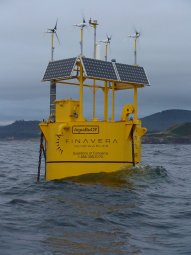
finavera-aquabuoy.jpg

An offshore wave farm will supply Californians with clean green electricity generated by the ocean, under a first-of-its-kind power purchase agreement that utility PG&E will announce Tuesday morning.

The giant San Francisco-based utility has signed a long-term contract to buy 2-megawatts of electricity from Finavera Renewables’ wave-energy power plant, to be built off the Northern California coast. The Vancouver company intends to eventually expand the Humboldt County project into a 100-megawatt “wave park.” It is likely to be the first of a score of floating power stations dotting California’s 1,100-mile coastline in the coming years, judging by the stack of applications for such wave farms on file at the Federal Energy Regulatory Commission.

“This power purchase agreement is extremely significant and reflects the massive potential for wave power as a renewable source of energy in the future,” says PG&E spokesman Keely Wachs. Like the Golden State’s other big investor-owned utilities — Southern California Edison (EIX) and San Diego Gas & Electric (SRE) — PG&E (PCG) must obtain 20 percent of its electricity from renewable sources by 2010 and 33 percent by 2020.

“The California market is huge for wave energy,” Finavera CEO Jason Bak told Fortune’s Green Wombat. “This is the first power purchase agreement with a large utility, and we see this as being one of the key components to commercializing wave energy technology.”

The ocean as potential source of greenhouse gas-free power is tremendous: The energy locked up in the surf rolling toward the California coast is equivalent to some 37 gigawatts — enough to light nearly 30 million homes — according to PG&E. And unlike the sun and wind, waves can generate electricity 24/7. But the technology to tap all that water-borne power and deliver it at competitive prices remains in the start-up phase.

PG&E and Finavera would not disclose the terms of the power purchase agreement. But Bak acknowledged that the key challenge he and other wave-energy companies face is “advancing the technology to the stage where we have a near-commercial technology.”

Finavera plans to deploy strings of connected wave-energy converters that it calls AquaBuoys. As waves roll past an array of AquaBuoys connected to an onshore station by an undersea cable, two-stroke hose pumps convert their energy into pressurized seawater that drives electricity-generating turbines. According to filings Finavera has made with the Federal Energy Regulatory Commission, a fully built-out 100 megawatt Humboldt wave farm would consist of 200 to 300 AquaBuoys floating on a two-square-mile site about two to three miles off the town of Trinidad. The initial phase of the project is expected to go online in 2012 and will use eight AquaBuoys.

While PG&E is merely dipping its corporate toe in the wave-energy waters with a relatively small 2-megawatt power purchase agreement, the deal with Finavera is likely to intensify efforts to stake claims on the best stretches of coast.

PG&E itself earlier this year unveiled its WaveConnect project to build two 40-megawatt wave farms, one off Humboldt and the other off the Mendocino County coast. Chevron (CVX) dived in last July with a plan for a Humboldt wave farm to be built by Scotland’s Ocean Power Delivery — now called Pelamis Wave Power — before abruptly pulling its application a month later.

Over the past two months there’s been a new flurry of applications. New Jersey’s Ocean Power Technologies (OPTT) in November filed for a FERC permit for a 20-megawatt “wave energy park” to be located off the Humboldt coast. And a newcomer to the wave energy business called GreenWave Energy Solutions has filed permit applications for wave farms off Mendocino and the Central Coast town of Moro Bay in San Luis Obispo County. (The Thousand Oaks, Calif., company lists a San Francisco attorney as its president and it was registered by a Southern California developer.)

Before Finavera can begin construction of the Humboldt wave farm, it must first spend two to three years completing environmental impact studies and negotiating with local, state and federal regulators. While obtaining financing for wave-energy projects using untried technology is difficult, Finavera will have one advantage over its competitors: a long-term power purchase agreement with one of the United States’ largest utilities.

“This PPA is a vote of confidence from PG&E that we can get the project done,” says Bak.

Read Full Post »

« Newer Posts - Older Posts »

Design a site like this with WordPress.com
Get started