Feeds:
Posts
Comments

Archive for the ‘alternative energy’ Category

This post first appeared on Grist.

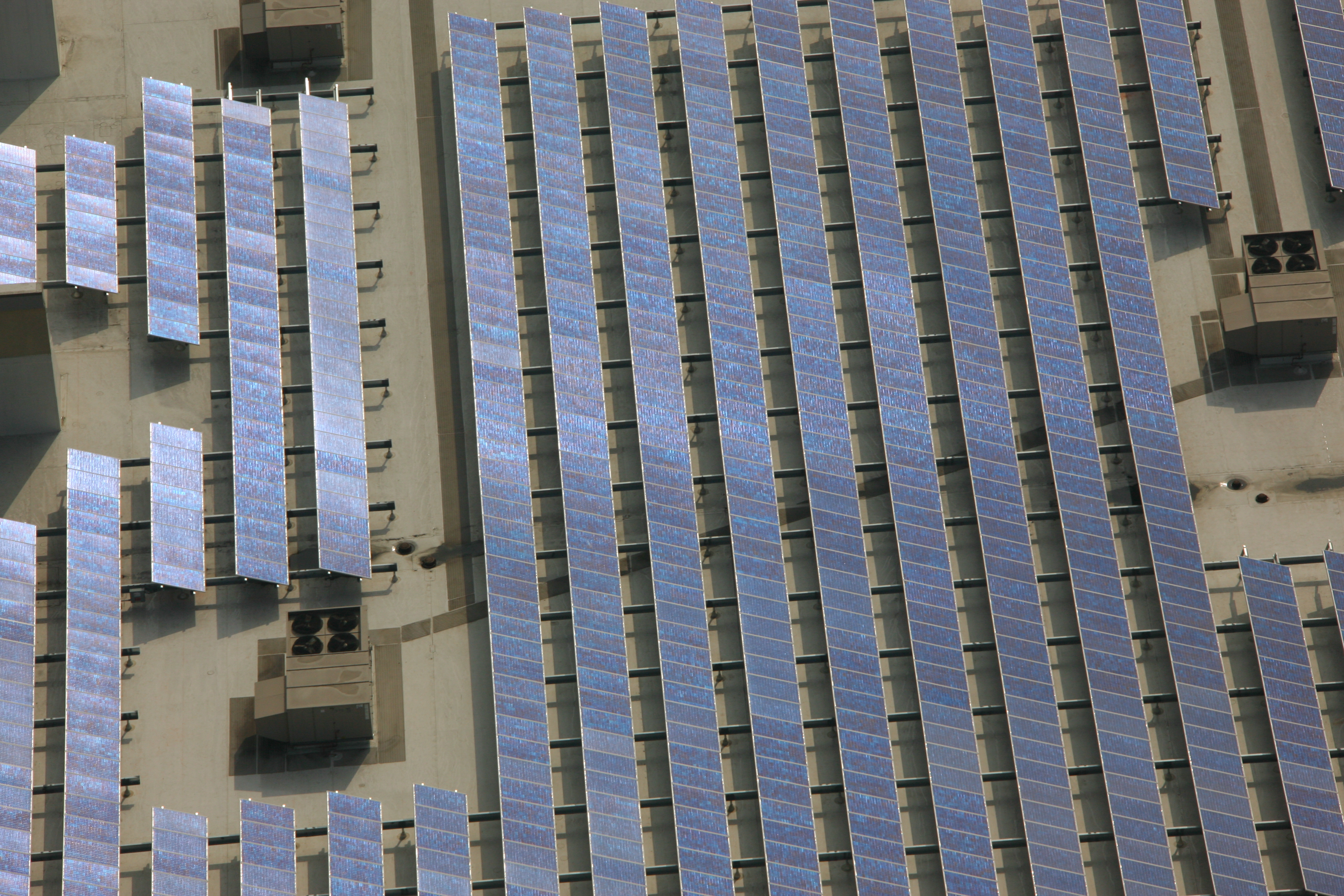
Legislation pending in New York that would require the state to install 5,000 megawatts of solar power by 2025 could generate 22,198 jobs and boost the economy by $20 billion, according to a report released by Vote Solar on Wednesday.

The cost to consumers would be just a 39-cent-a-month hike on their utility bills, the report found.

Vote Solar, a San Francisco non-profit that is backing the bills in the New York legislature along with the Natural Resources Defense Council and other environmental groups, commissioned the study conducted by Crossborder Energy. Described as an independent consultant, Crossborder relied on economic models developed by the National Renewable Energy Laboratory to make its projections.

“We note that in an effort to be conservative in our assumptions, these benefits are calculated without taking into account any potential new manufacturing,” the report stated. “Precedent shows that states that make a clear commitment to clean energy see reciprocal investment on behalf of manufacturing companies. For example, in both Arizona and California, the states’ strong and transparent policies were fundamental to the decisions of two major global solar manufacturers…to locate their first domestic manufacturing operations in those states.”

New York currently has less than 25 megawatts of solar installed. The New York Solar Jobs and Development Act would require the state’s utilities to install enough solar to account for at least 2.5 percent of their electricity sales by 2025. Those targets could be reached through residential and commercial rooftop solar installations or by building solar power plants. Utilities could own and operate their own solar power facilities to meet 25 percent of their mandate.

But the legislation does not specify incentives or other policies to encourage solar installations, which would inevitably affect the cost of the program for developers and consumers.
Read Full Post »

photo: BrightSource Energy

In last Thursday’s New York Times, I wrote about French industrial conglomerate Alstom’s $55 million investment in BrightSource Energy, a California-based solar power plant builder:

Alstom, the French energy giant, has taken a $55 million stake in BrightSource Energy, a solar power plant builder backed by Google, Morgan Stanley and other investors.

The investment is part of a $150 million round raised by BrightSource in one of the biggest renewable energy deals of the year. The California State Teachers Retirement System also joined the latest funding round as did the existing investors VantagePoint Venture Partners, Morgan Stanley and Draper Fisher Jurvetson.

Based in Oakland, Calif., BrightSource has now raised more than $300 million. Alstom becomes one of the startup’s largest shareholders and will take a seat on the board, according to John Woolard, BrightSource’s chief executive. The French company makes turbines and other power systems for fossil fuel, nuclear and hydro power plants and operates a division that builds high-speed trains.

BrightSource has signed contacts to build solar thermal power plants in California that would generate some 2,600 megawatts. In February, the company obtained a $1.37 billion loan guarantee from the federal government to help finance the construction of its first project, a 392-megawatt power plant to be built in the Southern California desert by Bechtel.

Mr. Woolard said Alstom would help the company as it sought to develop more efficient solar power plants.

You can read the rest of the story here.

Read Full Post »

photo: Todd Woody

Green Wombat has been in transition so I’m a bit behind on posting. In case you missed it, in the Sunday New York Times on May 9, I wrote a profile of David Gelbaum, one of the nation’s biggest — and until now — most reclusive green technology investors and environmental philanthropists:

AMID the $6 million homes perched on a beachfront cliff in this conservative Southern California enclave, the seven-year-old Honda Civic hybrid with the Obama bumper sticker is the giveaway.

It’s not the usual drive of choice for wealthy former hedge fund managers like David Gelbaum. Then again, there’s not much that is business as usual about Mr. Gelbaum, an intensely private person who happens to be one of the nation’s largest — and largely unknown — green technology investors and environmental philanthropists.

Mr. Gelbaum has invested $500 million in clean-tech companies since 2002 through his Quercus Trust, amassing a portfolio of some 40 businesses involved in nearly every aspect of the emerging green economy, be it renewable energy, the smart electric grid, sustainable agriculture, electric cars or biological remediation of oil spills. He has poured almost as much into environmental causes.

“I think his impact on green technology is huge,” says Bill Gross, the serial technology entrepreneur and founder of eSolar, a solar power start-up in which Mr. Gelbaum has invested. “He is supporting bolder and riskier bets, and he’s doing it from a different filter than a traditional venture capitalist, and I think that makes a wider opportunity for success.”

In this economic downturn, many venture capitalists have grown cautious about putting money into what Vinod Khosla, the prominent Silicon Valley green tech investor, calls “science experiments.” But Quercus Trust is still taking chances on blue-sky start-ups pursuing technological breakthroughs.

Working outside the clubby venture capital network, Mr. Gelbaum has, until recently, maintained an obsessively low profile. In Silicon Valley, he remains something of an unknown. Associates say his near-invisibility is owed to a genuine modesty and concerns over the security of his family because of his wealth. Recipients of his philanthropy, for instance, signed confidentiality agreements that forbade mention of his name.

Mr. Gelbaum says he decided to break his long silence upon becoming chief executive in February of Entech Solar, one of his portfolio companies that is publicly traded. “This is what’s best for the company,” he says, pointing out that Entech benefits if he maintains a more public profile.

It is too early to predict whether Mr. Gelbaum’s big green bets will pay off. But he’s been capitalizing on two trends: the rapid decline in the price of photovoltaic power, and a focus on cutting capital costs as solar power competition with China intensifies.

His environmental philanthropy also gives him an influence beyond laboratories and boardrooms. He has given $200 million to the Sierra Club and $250 million to the Wildlands Conservancy, a land trust he co-founded that has acquired and preserved 1,200 square miles of land in California, including more than a half million acres of the Mojave Desert.

You can read the rest of the story here.

Read Full Post »

Photo: Amonix

In The New York Times on Wednesday, I wrote about Southern California solar company Amonix scoring one of the biggest rounds of green tech funding this year — $129.4 million from investors led by Silicon Valley heavyweight Kleiner Perkins Caufield & Byers:

In one of the biggest green technology deals of the year, a prominent Silicon Valley venture capital firm is leading a $129.4 million investment in a long-promising solar technology that is starting to gain traction in the United States.

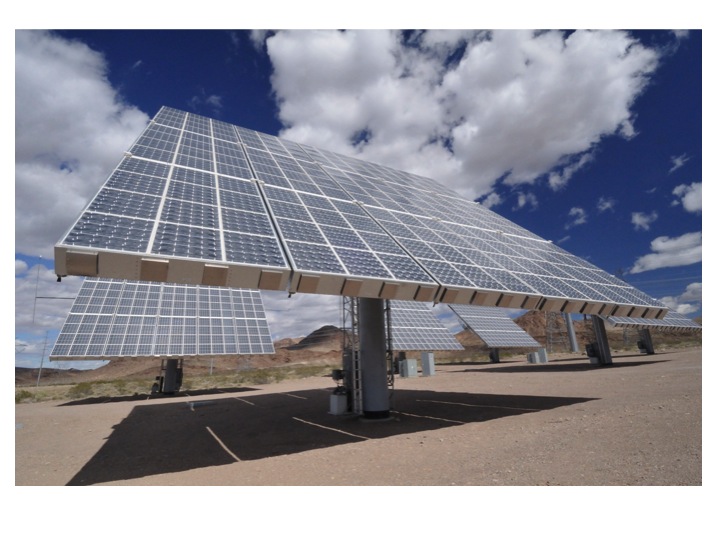
The venture firm, Kleiner Perkins Caufield & Byers, and other investors are making a big bet on Amonix, a company in southern California that has spent 20 years developing concentrating photovoltaic power systems that resemble gigantic solar panels.

Plastic lenses focus the sun on tiny but highly efficient solar cells to generate more electricity than conventional photovoltaic panels. The so-called multijunction cells, which were first developed to power satellites, use fewer expensive semiconducting materials like silicon.

“We have reviewed hundreds of solar companies, and Amonix stands out to us as one that has breakout potential,” said Ben Kortlang, a partner at Kleiner Perkins who formerly helped lead the alternative-energy investing unit at Goldman Sachs. “We believe this is the low-cost solar technology for sunny climates.”

You can read the rest of the story here.

Read Full Post »

Photo: SolFocus

In The New York Times on Thursday, I wrote that Silicon Valley startup SolFocus is building the first large concentrating photovoltaic power plant in the United States:

The nation’s first big concentrating photovoltaic power plant is under construction in the California desert.

SolFocus, a Silicon Valley startup, is building the one-megawatt solar farm for Victor Valley College in Victorville, a desert community northeast of Los Angeles.

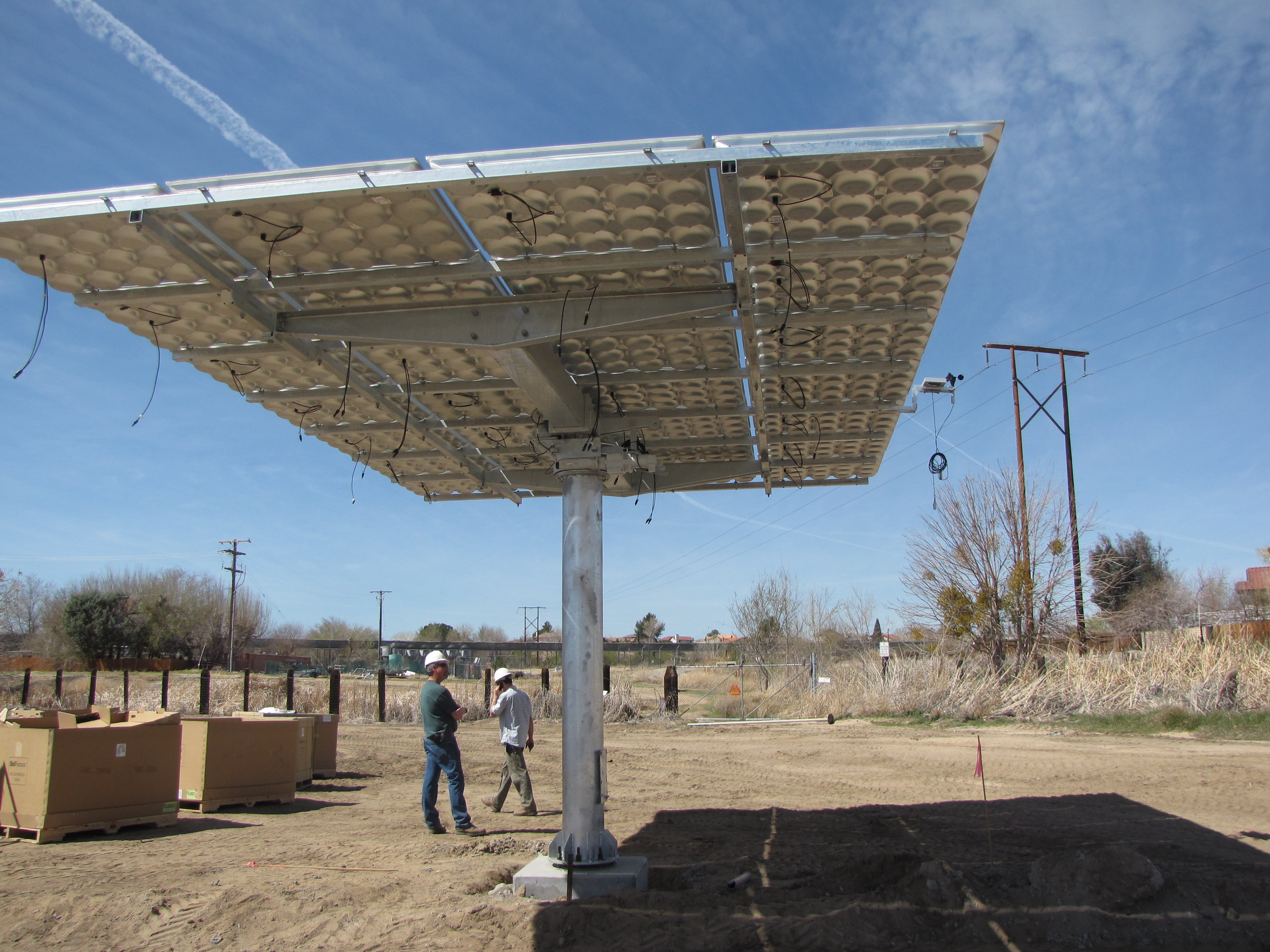
The company builds large solar panels that contain small mirrors that concentrate sunlight onto tiny, high-efficiency solar cells. Though more expensive than conventional solar cells, they use a fraction of the silicon and produce more electricity. That means less land is needed for a SolFocus power plant than one deploying conventional photovoltaic panels.

The SolFocus panels are mounted on trackers that follow the sun throughout the day. While SolFocus has built power plants in Europe, the California project is its first solar farm in the United States. Victor Valley College selected SolFocus after receiving competitive bids from several companies that install conventional photovoltaic panels and thin-film solar systems.

“After reviewing several options for a solar provider, SolFocus demonstrated that it could deliver the best value in solar energy for the college,” Robert Silverman, Victor Valley College’s president, said in a statement. The SolFocus power plant will supply about 30 percent of the college’s overall electricity demand.

SolFocus’ technology needs strong, direct sunlight to maximize electricity production. “If this deployment had been in somewhere in Northern California or Washington or Oregon, we probably wouldn’t have won the battle,” said Nancy Hartsoch, a vice president of marketing at SolFocus. Ms. Hartsoch added that in desert regions, the company’s technology generates electricity at prices competitive with traditional photovoltaic panels.

You can read the rest of the story here.

Read Full Post »

photo: Alcoa

In The New York Times on Thursday, I wrote about how aluminum giant Alcoa has become the latest industrial behemoth to jump into the solar business:

Alcoa, the aluminum giant, is testing a new type of solar technology that the company said it believed will lower the cost of renewable energy.

The company has replaced the glass in parabolic troughs with reflective aluminum and integrated the mirror into a single structure.

Parabolic troughs focus sunlight on liquid-filled receivers suspended over the mirrors to create steam that drives an electricity-generating turbine. Parabolic trough technology has been in modern use in solar power plants since the early 1980s, but Alcoa executives said they saw an opportunity to refine the technology and get a foothold in the rapidly expanding renewable energy market.

“If you go out and look behind large parabolic troughs, you’ll find an elaborate truss structure,” said Rick Winter, a technology executive with Alcoa. “From our understanding of aerospace structures, we said if we can modify the wing box design used in aircraft and integrate a parabolic reflector, it would give us a light and stiff structure that would fundamentally affect the cost equation.”

An airplane’s wing box is a unit that integrates support structures and anchors a wing.

“Using aluminum and a wing box design we’re able to create the parabolic curve that we want in the structure itself,” said Scott Kerns, a vice president and general manager at Alcoa. “We can make the skin conform more or less to the way we want to concentrate the light.”

Current solar troughs use glass mirrors that are formed in the shape of a parabola and then attached to a support structure made of aluminum or steel. The executives said they estimate that the all-aluminum Alcoa parabolic trough, which is being tested at the National Renewable Energy Laboratory in Colorado, will cut the price of a solar field by 20 percent due to lower installation costs.

You can read the rest of the story here.

Read Full Post »

Photo: BrightSource Energy

In The New York Times on Wednesday I write that California regulators have recommended approval of BrightSource Energy’s 392-megawatt solar thermal power plant, the first large-scale project in the state in two decades:

California regulators on Wednesday recommended that the state’s first new big solar power plant in nearly two decades be approved after a two-and-half year review of its environmental impact on the Mojave Desert.

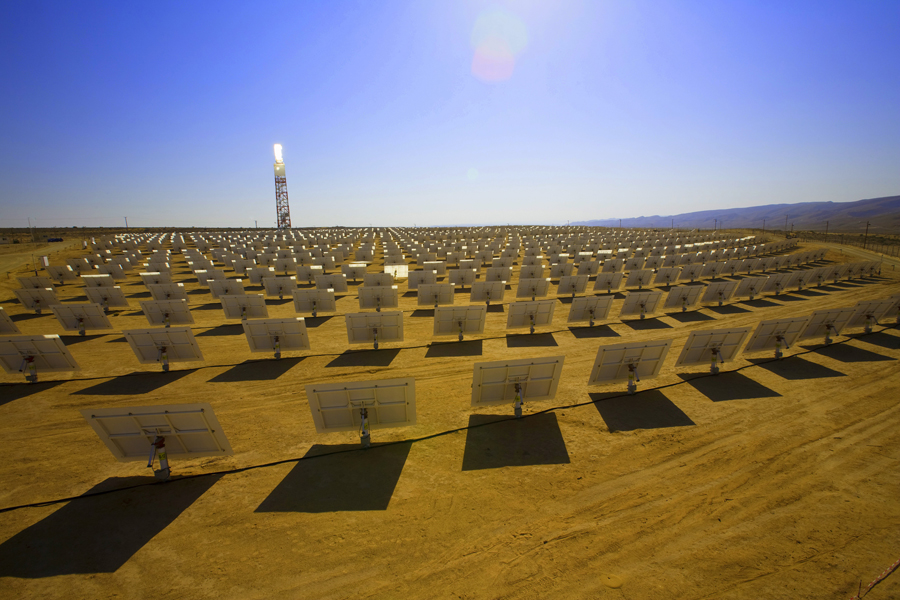
The recommendation by the California Energy Commission staff comes three weeks after the United States Department of Energy offered the project’s builder, BrightSource Energy, a $1.37 billion loan guarantee to construct the 392-megawatt Ivanpah Solar Electric Generating System, or I.S.E.G.S.

The Sierra Club, Defenders of Wildlife and the Center for Biological Diversity favor solar energy projects but objected to building the BrightSource power plant in Southern California’s Ivanpah Valley, saying it would harm rare plants and animals such as the desert tortoise.

Other environmentalists argued that the project, which features thousands of mirrors that focus the sun on 459-foot-tall towers, would mar the visual beauty of the desert.

In an assessment filed on Tuesday, energy commission staff found that a smaller version of the project that BrightSource proposed last month would mitigate any damage to several protected plant species on the site.

Environmentalists, however, had said the downsized version of the power plant would not sufficiently protect rare species and continued to push for the project’s relocation to more disturbed land.

The energy commission staff determined the visual impact of the Ivanpah power plant could not be reduced but recommended that the commission’s board license the project due to “overriding considerations.”

You can read the rest of the story here.

Read Full Post »

photo: Aurora Biofuels

As I write in The New York Times on Friday, it’s spring cleaning at three renewable energy firms as top executives depart SolarReserve, Clipper Windpower and Aurora Biofuels:

The past week has brought a spate of executive departures at renewable energy startups, with the president of SolarReserve, a power plant builder, and the chief executives of Clipper Windpower and Aurora Biofuels stepping down.

Terry Murphy, a rocket scientist who co-founded SolarReserve after a career at United Technologies’ Rocketdyne division, has started a new venture called Advanced Rocket Technologies in Commercial Applications, or ARTiCA. The firm will evaluate green technologies for entrepreneurs and investors, according to Mr. Murphy.

Mr. Murphy and SolarReserve both said the departure was voluntary. “With the company solidly executing on its business strategies, Mr. Murphy has transitioned to an external role in providing developmental expertise to other early stage clean energy companies,” wrote Debra Hotaling, a spokeswoman for SolarReserve, in an e-mail message.

When Mr. Murphy left Rocketdyne to start SolarReserve, the startup licensed Rocketdyne’s molten salt technology so that its solar power plants could store solar energy for use after the sun sets or on cloudy days.

“SolarReserve, in my opinion, is up and running on all four cylinders,” said Mr. Murphy.

“What I did at Rocketdyne and what I did at SolarReserve and what I’m looking at doing in the future is to sift through technologies to find those that can be commercialized.”

Mr. Murphy’s new firm will focus on technologies involving renewable energy, desalinization and sustainability, he said.

You can read the rest of the story here.

Read Full Post »

photo: Todd Woody

In The New York Times on Wednesday, I write about California regulators’ preliminary decision to reject requests by two big utilities to install grid-connected fuel cells:

While Google, Wal-Mart and other corporations have embraced fuel cells, California regulators have turned down requests from the state’s two biggest utilities to install the technology.

In a preliminary decision, an administrative law judge with the California Public Utilities Commission found unwarranted an application from Pacific Gas and Electric and Southern California to spend more than $43 million to install fuel cells that would generate six megawatts of electricity.

The technology transforms hydrogen, natural gas or other fuels into electricity through an electrochemical process, emitting fewer or no pollutants, depending on the type of fuel used.

“It is unreasonable to spend three times the price paid to renewable generation for the proposed Fuel Cell Projects, which are nonrenewable and fueled by natural gas,” wrote the administrative law judge, Dorothy J. Duda, in a proposed ruling issued last week. “In addition, the applications do not satisfactorily address how full ratepayer funding of utility-owned fuel cell generation would enhance private market investment and market transformation of the fuel cell industry.”

You can read the rest of the story here.

Read Full Post »

In The New York Times on Monday, I write about IBM’s new smart grid lab in Beijing that will develop technology for the global market:

In another sign of China’s emergence as an epicenter of green technology, I.B.M. has opened a lab in Beijing to develop smart grid software for the global market.

“We’re developing solutions for around the world but we’re looking to China to see how the pieces integrate across the value chain,” said Brad Gammons, I.B.M.’s vice president for sales and distribution for the company’s Energy and Utilities division.

Mr. Gammons himself has relocated to Beijing, where he will continue to oversee worldwide sales for the unit.

“The company made a decision that China is a very, very important growth market and to put some executives here,” he said in a telephone interview from Beijing. He said I.B.M. expects the new Energy & Utilities Solutions Lab to drive $400 million in revenue over the next four years.

It is operating out of I.B.M.’s 5,000-person China Development Laboratory. The new lab is working with the State Grid Corporation of China on pilot projects to integrate wind and solar power with the grid, manage grid operations and increase the efficiency of nuclear power plants.

The Chinese government has budgeted $7.3 billion for smart grid-related energy projects this year, according to ZPryme Research & Consulting, a firm based in Austin, Tex.

Mr. Gammons said electric cars will be one focus of I.B.M.’s new lab.

You can read the rest of the story here.

Read Full Post »

« Newer Posts - Older Posts »

Design a site like this with WordPress.com
Get started