Feeds:
Posts
Comments

Archive for the ‘alternative energy’ Category

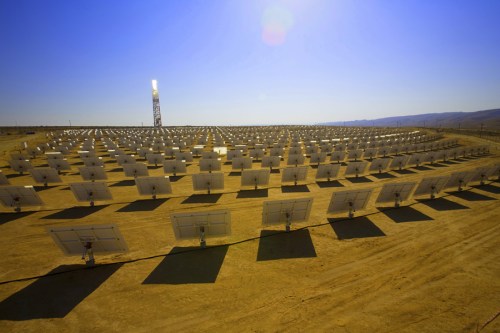
solarh

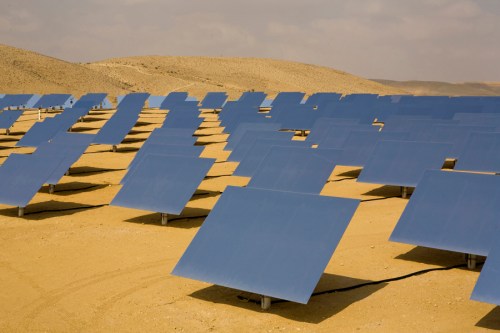
Photo: BrightSource Energy

In today’s New York Times, I write about how Harvey Whittemore — one of Nevada’s biggest power brokers and a confident of Senate majority leader Harry Reid — has responded to the housing crash by leasing desert land at his mega-home development to BrightSource Energy for a 960-megawatt solar farm complex.

What to do when building a 159,000-home city in the Nevada desert and the housing market collapses?

Go solar.

The Coyote Springs Land Company this week expanded a deal with BrightSource Energy, a solar power developer based in Oakland, Calif., to carve out 12 square miles of it its 43,000-acre mega-development for solar power plants that would generate up to 960 megawatts of electricity.

Harvey Whittemore, Coyote Springs’s chairman, said his plan always was to include some renewable energy in the massive golfing community under development 50 miles northeast of Las Vegas. But, Mr. Whittemore said, he decided to go bigger as the housing market crashed and solar developers like BrightSource began to sign deals with utilities.

“We’ve always said we’ll adjust the land use plan to the market,” said Mr. Whittemore in an interview. “At the end of the day we have approvals for 159,000 units and we looked at what we could do to reduce the number of units while at same time coming up with a functional business plan that takes advantage of private land.”

Private land is in short supply in Nevada, where the federal government owns about 87 percent of the state. That has forced solar developers like BrightSource – which is under the gun to supply 2,610 megawatts to California utilities — to seek leases on desert property managed by the United States Bureau of Land Management, a years-long process involving extensive environmental review.

By dealing with Mr. Whittemore, BrightSource is sidestepping all of that and acquiring an ally who knows how to get things done in the Silver State.

You can read the rest of the story here.

Read Full Post »

ausra-kimberlina

photo: Ausra

In my new Green State column on Grist, I sit down with legendary Silicon Valley venture capitalist Vinod Khosla to talk about his approach to green tech. Khosla — who raised a record $1.1 billion for green tech investing earlier this month — believes that unless a technology can scale and be adopted in markets like China and India, it will not have a meaningful impact on climate change.

Getting an audience with Silicon Valley’s guru of green investing isn’t always easy.

If Vinod Khosla is not speaking at one of the innumerable, and apparently recession-proof, green business conferences that seem to happen every other week, he’s giving lectures at Google headquarters, writing white papers, or, of course, inking checks to green tech startups with the potential to disrupt multi trillion-dollar global industries like energy, automobiles and building materials.

He’s something of a Valley legend:  Co-founder of Sun Microsystems, then a longtime tech investor with marquee venture capital firm Kleiner Perkins Caufield & Byers and now head of Khosla Ventures, which he started in 2004 to invest in green tech startups.

Khosla and his partners had been investing their own money, but earlier this month the firm announced it had raised $1.1 billion for two funds—one of which is the largest first-time fund in a decade. It was a rather staggering amount, given that clean-tech investing has plummeted from $4 billion in 2008 to $513 million so far this year, according to PricewaterhouseCoopers, as the “Great Recession” continues to take its toll.  Putting money into the two Khosla funds was the nation’s largest pension fund, the California Public Employees’ Retirement System.

It’s not the size of Khosla’s fund but what he intends to do with it that should command your attention. In short, he wants to take the green out of green investing and globalize the bottom line.

You can read the rest of the column here.

Read Full Post »

esolar_8
photo: eSolar

In Sunday’s Los Angeles Times, I write about how the rise of green technology is changing the way Silicon Valley venture capitalists do business:

Silicon Valley venture capitalists have always been about inventing the future — taking a wild idea, nurturing it with cash and creativity and giving birth to new products, companies and industries we once couldn’t imagine and now can’t conceive of living without: the Web, Google, the iPhone, Twitter.

But as green technology becomes the latest tech wave to break from the nation’s entrepreneurial epicenter, it’s now all about companies reinventing the past. Solar power companies, electric car start-ups and algae biofuel ventures aim to remake century-old trillion-dollar industries on a global scale.

Venture capitalists poured $4 billion into green-tech start-ups in 2008 — nearly 40% of all tech investments in the U.S., according to a survey by PricewaterhouseCoopers. Green-tech investment plunged in the first half of 2009 to $513 million as the recession dragged on, but there are signs of a rebound: Silicon Valley’s Khosla Ventures announced this month that it had raised $1.1 billion — the biggest first-time fund in a decade — that would be largely devoted to investing in green-tech start-ups, many in Southern California.

But green-tech companies face unique challenges, including global markets, tough technological hurdles and a future shaped by government incentives and regulatory policy. Those challenges are changing the game on Sand Hill Road.

“If you’re starting a Web 2.0 company, your basic needs are personnel and servers — there is no physical product, no manufacturing capacity, no inventory, no steel in the ground,” VantagePoint’s Salzman said, referring to software-based companies that provide services over the Internet.

Green-tech start-ups, he said, often need big money and investors steeped in big science and big government.

You can read the rest of the story here.

Read Full Post »

_MG_7360-01

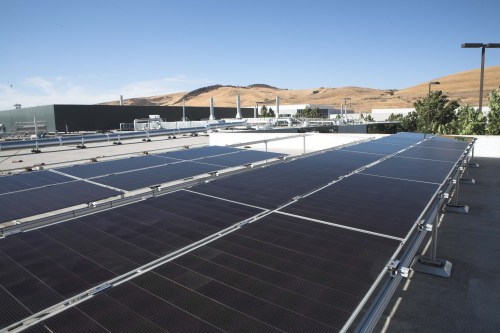
photo: Nanosolar

A day after First Solar made waves with its agreement with the Chinese government to build a 2,000-megawatt solar farm in Mongolia, Silicon Valley startup Nanosolar took the wraps off its much-hyped thin-film photovoltaic technology and announced it has booked $4.1 billion in orders from solar developers. As I write in today’s New York Times:

Since its founding in 2002, Nanosolar has raised a lot of money – half a billion dollars to date – and made a lot of noise about upending the solar industry, but the Silicon Valley start-up has been a bit vague on specifics about why it’s the next big green thing.

On Wednesday, Nanosolar pulled back the curtain on its thin-film photovoltaic cell technology — which it claims is more efficient and less expensive than that of industry leader First Solar — and announced that it has secured $4.1 billion in orders for its solar panels.

Martin Roscheisen, Nanosolar’s chief executive, said customers include solar power plant developers like NextLight, AES Solar and Beck Energy of Germany.

The typical Nanosolar farm will be between 2 and 20 megawatts in size, Mr. Roscheisen said in an e-mail message from Germany, where he was attending the opening of Nanosolar’s new factory near Berlin. “This is a sweet spot in terms of ease of permitting and distributed deployment without having to tax the transmission infrastructure.”

You can read the rest of the story here.
Read Full Post »

solarh
Photo: BrightSource Energy

In another sign that old-line corporate giants see solar power as big business, engineering and construction giant Bechtel has signed a deal with BrightSource Energy to build the solar developer’s first solar power plant, a 440-megawatt project in Southern California on the Nevada border. As I write in Wednesday’s New York Times:

Bechtel, the global engineering and construction giant, has jumped into the solar power plant business in a deal with a developer to build a 440-megawatt energy complex in California.

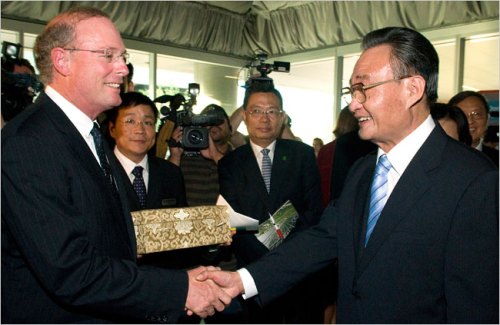
The agreement, being announced Wednesday, calls for Bechtel’s development and finance arm, Bechtel Enterprises, to take an equity stake in the solar project known as the Ivanpah Solar Electricity Generating System. The collection of three solar power stations will deliver electricity to Pacific Gas & Electric and Southern California Edison.

Bechtel is teaming up with BrightSource Energy, a start-up company based in Oakland, Calif.

Ivanpah is the first large-scale solar power plant to undergo regulatory review in the United States in nearly two decades, and the selection of Bechtel as BrightSource’s engineering, procurement and construction contractor is considered a significant step in obtaining financing needed to build the project.

You can read the rest of the story here.
Read Full Post »

first solar

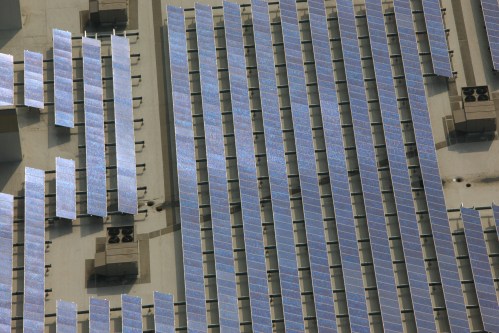
Photo: First Solar

First Solar became the first U.S. solar company to break into the Chinese market on Tuesday and it did do in a big way when it signed an agreement to build a two-gigawatt thin-film solar power plant in Inner Mongolia. As I write in The New York Times:

Chinese government officials signed an agreement on Tuesday with First Solar, an American solar developer, for a 2,000-megawatt photovoltaic farm to be built in the Mongolian desert.

Set for completion in 2019, the First Solar project represents the world’s biggest photovoltaic power plant project to date, and is part of an 11,950-megawatt renewable-energy park planned for Ordos City in Inner Mongolia.

The memorandum of understanding between Chinese officials and First Solar, the world’s largest photovoltaic cell manufacturer, would open a potentially vast solar market in China and follows the Chinese government’s recent moves to accelerate development of renewable energy.

You can read the rest of the story here.
Read Full Post »

ausra-kimberlina

photo: Ausra

In Wednesday’s Los Angeles Times, I write about green tech guru Vinod Khosla’s new $1.1 billion venture funds — the biggest first-time fund since the halcyon days of the dot-com era a decade ago and and a strong signal that investors see a bright future in clean and green technologies. CalPERS, the United States’ biggest pension fund, is the major backer of the new Khosla Ventures’ funds:

In a sign that green technology investing is bouncing back, Silicon Valley venture capital firm Khosla Ventures said Tuesday that it had raised $1.1 billion to spur development of renewable energy and other clean technologies.

It is the biggest first-time fund in a decade and comes as venture capital investment in green technology is just beginning to recover from a precipitous fall prompted by the global economic collapse last fall.

In the first half of the year, investments in green tech plunged to $513 million from $2 billion in the first six months of 2008, according to a survey by PricewaterhouseCoopers.

But Vinod Khosla, founder of Khosla Ventures in Menlo Park, Calif., and a leading green tech guru, has managed to raise an $800-million fund to invest in early and mid-stage clean energy and information technology companies as well as a $275-million fund to finance what he called high-risk “science experiments” that may exist only in a university laboratory.

You can read the rest of the story here.
Read Full Post »

solarcells

photo: Southern California Edison

It hasn’t received much media attention, but the California Public Utilities Commission has just proposed instituting a first-of-its-kind reverse auction market to spur renewable energy development — mainly solar photovoltaic.  As I write today in The New York Times:

California regulators are taking an eBay approach to ramping-up renewable energy in the Golden State.

In what might be a world first, the California Public Utilities Commission on Thursday proposed letting developers bid on contracts to install green energy projects. A solar company that offers to sell electricity to one of California’s three big utilities at a rate lower than its competitors would win a particular power purchase agreement.

This “reverse auction market” feed-in tariff is designed to avoid the pitfalls the have plagued efforts in Europe to encourage development of renewable energy by paying artificially high rates for electricity produced by solar power plants or rooftop photovoltaic projects.

You can read the rest of the story here:

Read Full Post »

solara

photo: BrightSource Energy

Chevron and solar developer BrightSource Energy have revealed a deal for a solar steam plant that is being built in an oil field in California. As I wrote in The New York Times this week:

BrightSource Energy has broken ground on a 29-megawatt solar steam plant at a Chevron oil field in Coalinga, Calif.

The 100-acre project’s 7,000 mirrors will focus sunlight on a water-filled boiler that sits atop a 323-foot tower to produce hot, high-pressure steam.

In a conventional solar power plant, the steam drives a turbine to generate electricity. In this case, the steam will be injected into oil wells to enhance production by heating thick petroleum so it flows more freely. Oil companies typically rely on steam generated by natural gas or other fossil fuels to maximize oil recovery in places like the oil patch in California’s Fresno and Kern counties, where the petroleum is heavy and gooey.

You can read the rest of the story here:

Read Full Post »

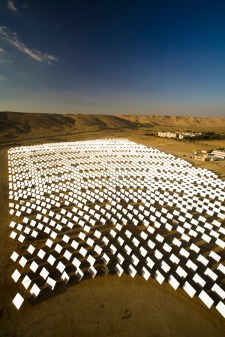
solarF

In Monday’s New York Times’ Green Inc. blog, I take a look at two recently approved solar energy contracts in California that offer a rare look at the economics of large-scale solar power plants:

California regulators have approved contracts for more than 8,600 megawatts of renewable energy, to be generated mostly by big solar power plants for the state’s largest utilities. But the details of those deals and the emerging economics of green energy often remain shrouded in secrecy, subject to confidentiality agreements.

That black box cracked open a bit on Thursday, when the California Public Utilities Commission gave the green light to two 25-year power purchase agreements between Pacific Gas & Electric and BrightSource Energy, a solar power plant builder based in Oakland, Calif.

When approving contracts for 310 megawatts of solar electricity, the utilities commission also signed off on an apparently first-of-its-kind technology royalty agreement between BrightSource and PG&E.

You can read the rest of the story here.
Read Full Post »

« Newer Posts - Older Posts »

Design a site like this with WordPress.com
Get started